The Planets Where a Day Isn't 24 Hours
From days that last 10 hours to a day longer than a year. Comparing day lengths across the solar system.
November 4, 2026 · 2 min read
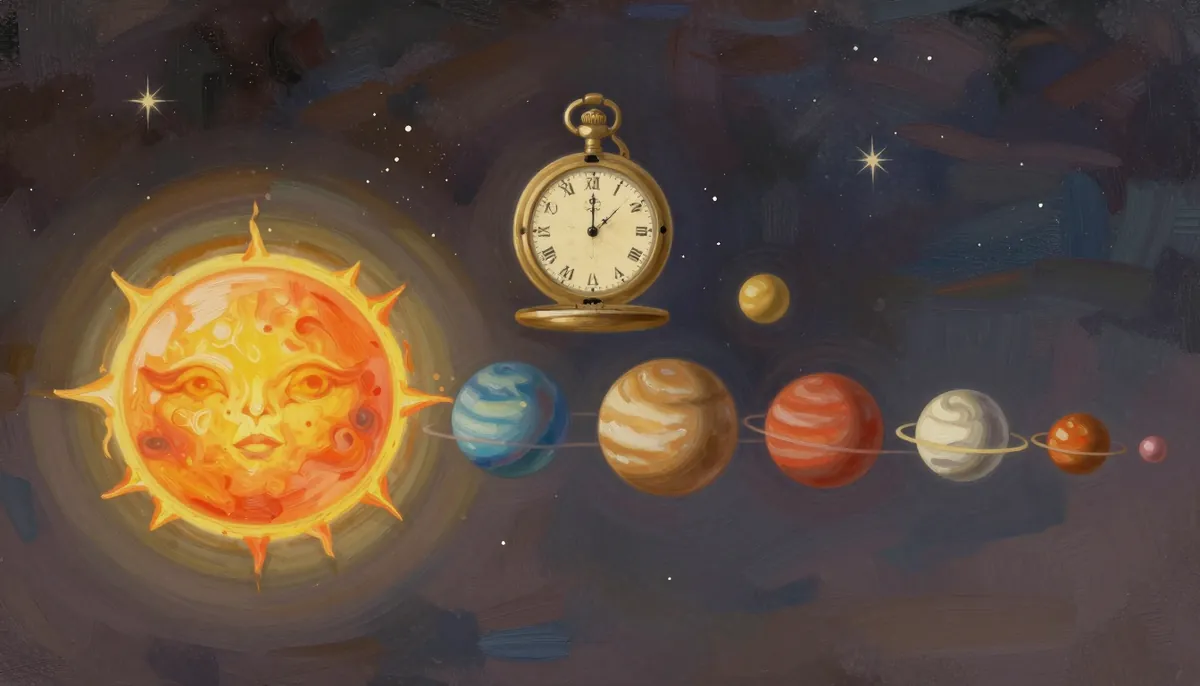
A day on Earth is 24 hours. It’s so obvious we never think about it. But travel to another planet in the solar system and ‘a day’ means something completely different.
Here, ‘day’ means a planet’s rotation period: the time it takes to spin once. The time from one sunrise to the next (the solar day) can differ because the planet is also orbiting the Sun.
The shortest day: Jupiter, about 10 hours
Jupiter, the biggest planet, spins the fastest: about 9 hours 56 minutes per turn. Spinning that fast makes it bulge at the equator. Saturn is almost as quick, at about 10 hours 33 minutes.
The most Earth-like day: Mars
Mars rotates in about 24 hours 37 minutes, almost the same as Earth. Mission teams call a Martian day a ‘sol’. While operating rovers on Mars time, their schedules drifted about 40 minutes later every day.
The weirdest day: Venus
Venus spins very slowly, and backwards. One rotation takes about 243 days, while one trip around the Sun takes about 225. So its day is longer than its year. And because it spins the opposite way from most planets, the Sun rises in the west and sets in the east.
The planet that rolls: Uranus
Uranus is tilted about 98 degrees, so it rolls around nearly on its side. A day lasts about 17 hours, but its poles get seasons of roughly 42 years of daylight followed by 42 years of night.
At a glance
| Planet | Rotation period (approx.) |
|---|---|
| Mercury | 59 days |
| Venus | 243 days (retrograde) |
| Earth | 23 h 56 min |
| Mars | 24 h 37 min |
| Jupiter | 9 h 56 min |
| Saturn | 10 h 33 min |
| Uranus | 17 h 14 min |
| Neptune | 16 h 6 min |
Notice that Earth’s rotation is 23 hours 56 minutes, not 24 hours? Because Earth is moving around the Sun, it has to turn about 4 minutes more for the Sun to return to the same spot in the sky. That’s the 24-hour day we know.
Earth’s day is getting longer
Tides raised by the Moon act like a brake on Earth’s spin, so our days are very slowly getting longer, by roughly 2 milliseconds per century. Far too little to notice, but in the age of the dinosaurs, days were shorter than they are now.
How much space trivia do you know? 👉 Space Trivia Quiz