How Do Our Eyes See Color? Cone Cells and Color Blindness
Three kinds of cells for red, green and blue, the color vision deficiency 1 in 12 men have, and the dress photo that broke the internet. The secrets of how we see color.
November 4, 2026 · 2 min read
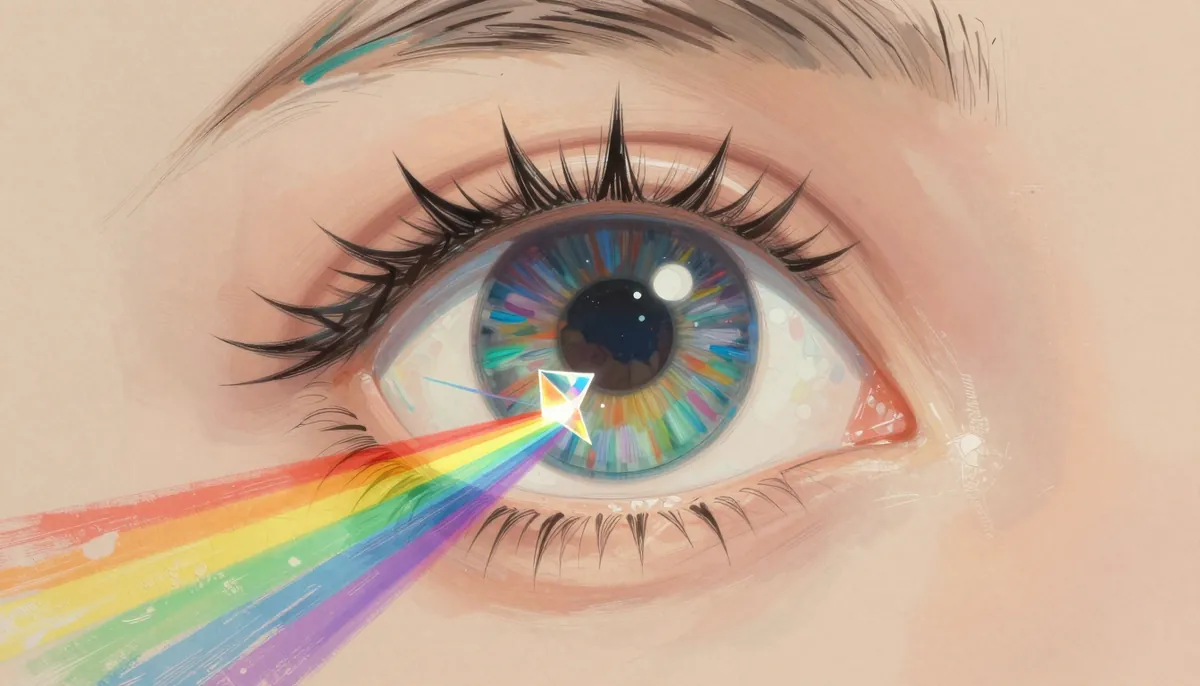
Apples are red and the sky is blue. Yet there’s no “red” inside an apple. Color is a sensation created together by light, your eyes and your brain.
The color cells: cones
The retina at the back of your eye has two kinds of light-sensing cells.
- Rods: about 120 million. They sense light and dark in dim conditions but can’t tell colors apart. That’s why things look grayish at night.
- Cones: about 6 million. They distinguish colors in bright light.
Cones come in three types, each most sensitive to short (blue-ish), medium (green-ish) or long (red-ish) wavelengths. Your brain compares the ratio of the three signals to create color. When you see yellow light, your green and red cones both respond, and your brain reads that combination as “yellow”.
Thanks to combinations of these three signals, people are commonly estimated to distinguish around a million colors. Your screen uses the same trick, mixing just red, green and blue light to create countless colors.
Color vision deficiency is more common than you think
If one of the three cone types works differently, some colors become hard to tell apart. The most common form is red-green color vision deficiency.
- Among people of Northern European ancestry, it affects about 1 in 12 men (8%) and 1 in 200 women (0.5%).
- The genes involved sit on the X chromosome, which is why it’s more common in men, who have only one X.
Most people with color vision deficiency get along fine day to day. But charts or signals that rely only on red versus green can be frustrating, which is why good design now pairs color with shapes or differences in brightness.
Same photo, different colors: the dress
In 2015, a photo of a dress split the internet. Some saw it as blue and black, others as white and gold.
The secret is the brain’s correction. Your brain guesses the color of the lighting and subtracts it to find an object’s “true” color. People who assumed bluish shade saw white and gold; people who assumed warm indoor light saw blue and black. The same light reached everyone’s eyes, but brains interpreted it differently.
Why color discrimination varies
- Screens and lighting: brightness, color settings and room light change how visible tiny differences are.
- Fatigue: tired eyes are worse at spotting subtle differences.
- Age: the lens slowly yellows with age, which can make blues harder to tell apart.
That’s why QuizWonders’ “Find the Odd Color” builds every puzzle from lightness differences only, so it stays as fair as possible for color-blind players.
How many levels can your eyes clear? 👉 Find the Odd Color