Why Does Reaction Time Vary? What Happens in 0.2 Seconds
From seeing green to moving your finger, the relay between eyes, brain and muscles. Plus the 0.1-second false-start rule in sprinting and how age and sleep affect your speed.
November 4, 2026 · 2 min read
Pulling away when the light turns green, catching a ball, clicking before your opponent in a game: it’s all about reaction time. What happens inside your body in that tiny moment?
A 0.2-second relay
From the screen turning green to your finger moving, the signal travels like this:
- Eyes: retinal cells turn the change in light into an electrical signal.
- Optic nerve → visual areas at the back of the brain: “the color changed” gets interpreted.
- Decision: “press now”.
- Motor areas → spinal cord → nerves in your arm and fingers: commands go to the muscles.
- Muscles contract: your finger actually moves.
Simple visual reaction time measured in labs is around 0.2 seconds. Interestingly, reactions to sound are a bit faster, because sound signals take a shorter processing route in the brain.
Online reaction tests usually show a little slower, around 0.25–0.3 seconds, because your monitor’s refresh (about 0.017 seconds per frame on a 60 Hz screen) and your mouse and computer add their own delays.
Sprinting’s 0.1-second rule
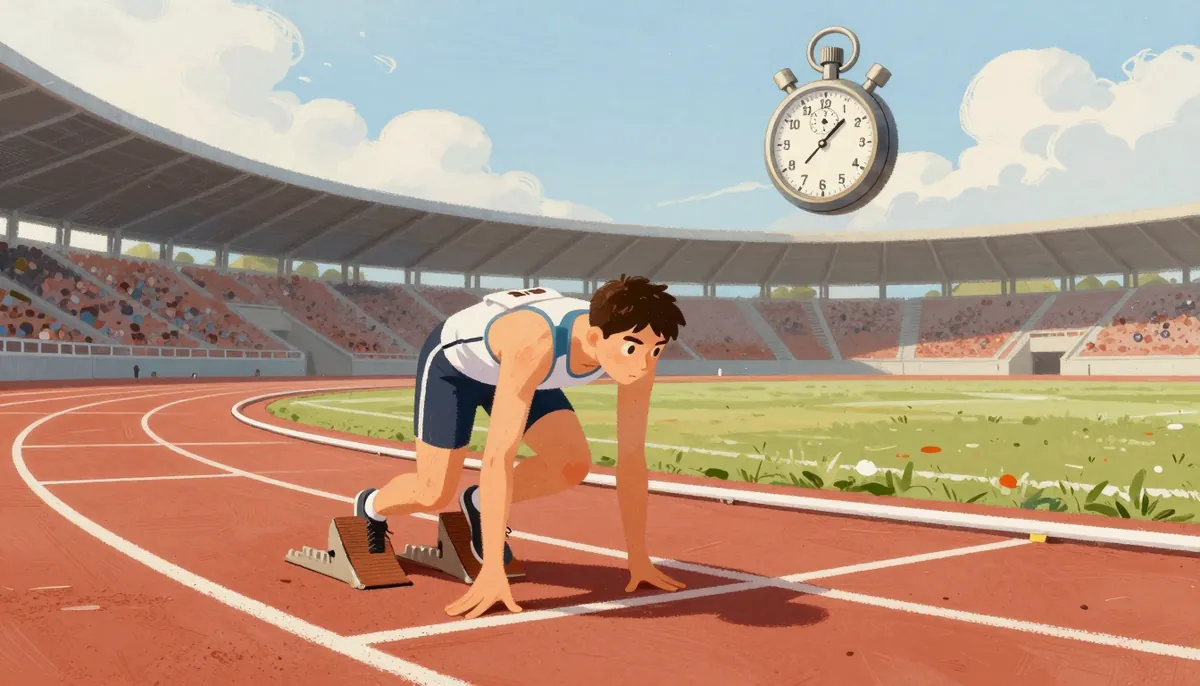
In sprint races, pushing off the starting blocks less than 0.1 seconds after the gun counts as a false start. The idea is that no human can genuinely react faster than that, so anyone moving sooner must have anticipated the gun rather than reacted to it.
What changes your reaction time
Age
Reaction speed peaks in your early-to-mid twenties and then slowly declines. A 2014 study of thousands of real-time strategy game players found that speed began to slip from around age 24. Experience helps older players read situations earlier, though, which closes much of the gap in practice.
Sleep
Sleep deprivation doesn’t just slow you down; it makes you inconsistent, mostly normal and then suddenly very late. That’s part of why drowsy driving is so dangerous.
Focus and readiness
You react faster when you know a signal is coming. That’s why reaction tests randomize the timing.
Practice
Repetition helps a little, but practice alone rarely gets anyone below about 0.15 seconds. Pros instead read opponents’ movements early, shrinking how much they actually need to react.
Tips for measuring yours
- Turn screen brightness up and use a wired mouse if you can.
- Look at the average of several tries; a single try is mostly luck.
- Don’t jump the gun. Press when you actually see green.
Ready for the world of 0.2 seconds? 👉 Reaction Time Test