Did a Chimpanzee Really Beat Humans at Memory? The Ayumu Study
In 2007 a young chimpanzee named Ayumu outperformed university students on a split-second number memory task. Here is what the experiment actually showed and what later studies found.
November 13, 2026 · 2 min read
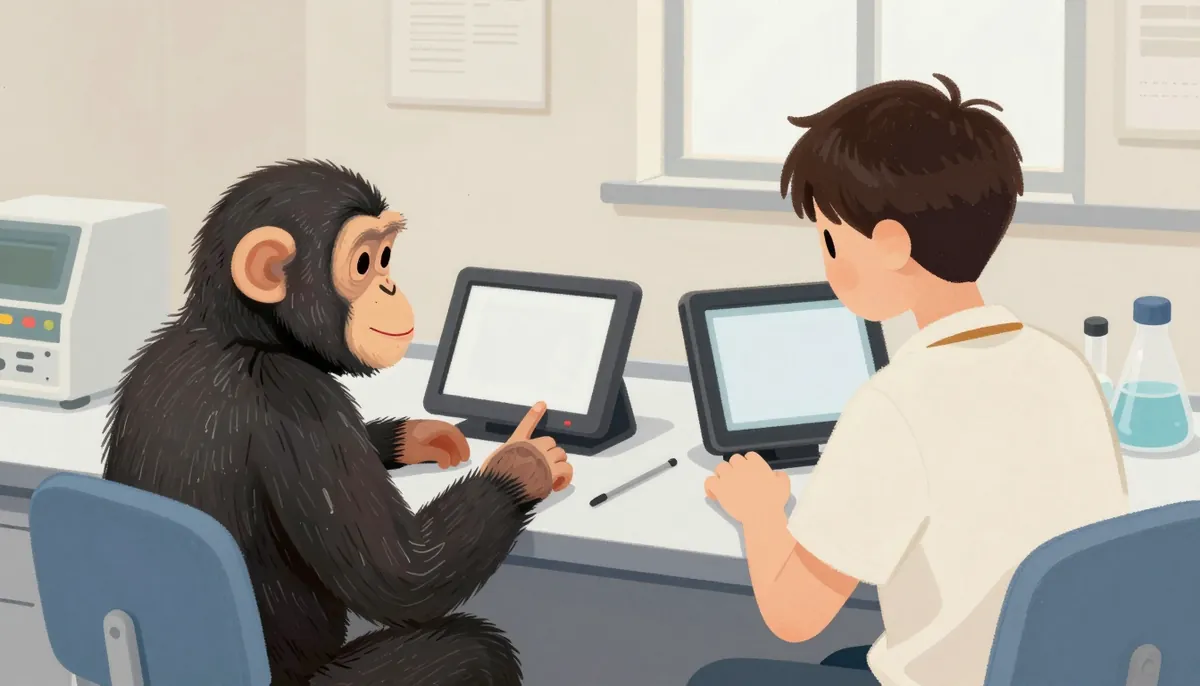
The “chimp test,” where numbers flash on a grid and you tap them back in order, is based on a real experiment, and its most famous participant was a young chimpanzee named Ayumu.
The experiment
In 2007, Sana Inoue and Tetsuro Matsuzawa of Kyoto University’s Primate Research Institute published a study in the journal Current Biology titled “Working memory of numerals in chimpanzees.” Ayumu, who was born in 2000, had learned the order of the numerals 1 to 9 on a touchscreen, as had his mother Ai and other chimpanzees at the institute.
In the key task, several numerals appeared at random spots on the screen. As soon as the participant touched the first number, the rest were replaced by blank white squares, and they had to touch the hidden squares in the correct order from memory. That is exactly how the chimp test works.
Where Ayumu won
The researchers also tried a harder version in which the numbers were shown only very briefly, for fractions of a second, before being masked. As the display time got shorter, the university students’ accuracy dropped, while Ayumu’s stayed high. At the shortest display times, the young chimpanzee clearly outperformed the humans.
It looked as if Ayumu could take in the whole layout at a single glance, almost like a snapshot, while the students needed more time to scan the screen.
Why might chimps be good at this?
Matsuzawa later proposed the cognitive tradeoff hypothesis: perhaps our ancestors gave up some of this snapshot-style memory as they developed language and other abstract skills. It is an intriguing idea, but it remains a hypothesis, not a settled fact.
What later studies found
The result was surprising enough that other researchers tested it. In 2009, Silberberg and Kearns reported that humans who practiced the task could reach accuracy comparable to Ayumu’s. Ayumu had years of training on the touchscreen, while the students in the original study had far less, so practice is a big part of the story.
The fairest summary is that Ayumu showed remarkable immediate memory, and that well-practiced humans can come much closer than the headlines suggested.
How to do better on the chimp test
- Take in the layout before tapping 1. Once you touch the first number, the clock is effectively running.
- Chunk the numbers. Group them into small shapes, like “2, 3 and 4 make a triangle in the corner.”
- Trace a path with your eyes. Follow the numbers in order once, like drawing a line through them.
- Practice. As the follow-up studies suggest, this kind of memory improves with repetition.
In short
In the 2007 Kyoto study, Ayumu the chimpanzee beat university students at remembering numbers flashed for a split second. Later work showed that practiced humans can come close, but the result is still one of the most famous memory experiments ever.
Think you can beat a chimpanzee? 👉 Take the Chimp Test